Does Eztag Read Liscense Plate or Sticker
A Quick Guide to GPLv3
![[GPLv3 Logo]](https://www.gnu.org/graphics/gplv3-127x51.png)
After a year and a half of public consultation, thousands of comments, and four drafts, version 3 of the GNU General Public License (GPLv3) was finally published on June 29, 2007. While there's been a lot of discussion virtually the license since the beginning draft appeared, non many people have talked nearly the benefits that information technology provides developers. We've published this guide to make full that gap. Nosotros'll start with a brief refresher on free software, copyleft, and the goals of the GPL. Nosotros'll then review the major changes in the license to come across how they advance those goals and benefit developers.
The Foundations of the GPL
Nobody should be restricted by the software they use. At that place are four freedoms that every user should have:
- the freedom to use the software for whatever purpose,
- the freedom to change the software to suit your needs,
- the freedom to share the software with your friends and neighbors, and
- the freedom to share the changes you lot brand.
When a program offers users all of these freedoms, we call it free software.
Developers who write software tin can release it under the terms of the GNU GPL. When they do, it will be free software and stay free software, no matter who changes or distributes the plan. We call this copyleft: the software is copyrighted, simply instead of using those rights to restrict users like proprietary software does, nosotros use them to ensure that every user has freedom.
We update the GPL to protect its copyleft from being undermined by legal or technological developments. The most recent version protects users from three recent threats:
- Tivoization: Some companies have created diverse different kinds of devices that run GPLed software, and so rigged the hardware so that they can change the software that'southward running, but you cannot. If a device tin run arbitrary software, it's a general-purpose computer, and its owner should control what it does. When a device thwarts you from doing that, nosotros call that tivoization.
- Laws prohibiting gratuitous software: Legislation similar the Digital Millennium Copyright Act and the European Matrimony Copyright Directive make it a criminal offense to write or share software that can break DRM (Digital Restrictions Management; see below). These laws should not interfere with the rights the GPL grants y'all.
- Discriminatory patent deals: Microsoft has recently started telling people that they will not sue gratis software users for patent infringement—as long equally yous get the software from a vendor that'due south paying Microsoft for the privilege. Ultimately, Microsoft is trying to collect royalties for the use of complimentary software, which interferes with users' liberty. No company should be able to do this.
Version 3 also has a number of improvements to brand the license easier for everyone to utilize and understand. Just fifty-fifty with all these changes, GPLv3 isn't a radical new license; instead it's an evolution of the previous version. Though a lot of text has changed, much of information technology simply clarifies what GPLv2 said. With that in mind, let's review the major changes in GPLv3, and talk near how they better the license for users and developers.
Neutralizing Laws That Prohibit Complimentary Software—But Not Forbidding DRM
You're probably familiar with the Digital Restrictions Management (DRM) on DVDs and other media. Yous're probably also familiar with the laws that make it illegal to write your own tools to bypass those restrictions, similar the Digital Millennium Copyright Act and the European Union Copyright Directive. Nobody should be able to stop you lot from writing any code that you want, and GPLv3 protects this right for you.
It'southward ever possible to apply GPLed lawmaking to write software that implements DRM. However, if someone does that with code protected by GPLv3, section 3 says that the system volition non count as an effective technological "protection" mensurate. This ways that if you break the DRM, you'll exist free to distribute your own software that does that, and yous won't exist threatened by the DMCA or similar laws.
As usual, the GNU GPL does not restrict what people do in software; information technology just stops them from restricting others.
Protecting Your Right to Tinker
Tivoization is a dangerous endeavour to curtail users' freedom: the right to modify your software will become meaningless if none of your computers let you do it. GPLv3 stops tivoization by requiring the benefactor to provide you with whatever information or information is necessary to install modified software on the device. This may exist as simple as a ready of instructions, or it may include special information such equally cryptographic keys or information nigh how to bypass an integrity bank check in the hardware. It will depend on how the hardware was designed—simply no thing what information you lot need, yous must be able to get it.
This requirement is limited in scope. Distributors are nevertheless allowed to utilize cryptographic keys for any purpose, and they'll only be required to disclose a cardinal if you need information technology to modify GPLed software on the device they gave you. The GNU Project itself uses GnuPG to show the integrity of all the software on its FTP site, and measures like that are beneficial to users. GPLv3 does non terminate people from using cryptography; we wouldn't desire it to. It only stops people from taking away the rights that the license provides you—whether through patent law, engineering, or any other ways.
Stronger Protection Against Patent Threats
In the 17 years since GPLv2 was published, the software patent landscape has changed considerably, and gratuitous software licenses have developed new strategies to address them. GPLv3 reflects these changes likewise. Whenever someone conveys software covered by GPLv3 that they've written or modified, they must provide every recipient with any patent licenses necessary to exercise the rights that the GPL gives them. In add-on to that, if any licensee tries to utilise a patent suit to stop another user from exercising those rights, their license will be terminated.
What this means for users and developers is that they'll be able to work with GPLv3-covered software without worrying that a drastic contributor will try to sue them for patent infringement later. With these changes, GPLv3 affords its users more defenses confronting patent aggression than whatever other free software license.
Clarifying License Compatibility
If you plant some code and wanted to comprise it into a GPLed project, GPLv2 said that the license on the other lawmaking was non allowed to have whatsoever restrictions that were non already in GPLv2. Equally long every bit that was the case, we said the license was GPL-compatible.
However, some licenses had requirements that weren't really restrictive, because they were then piece of cake to comply with. For example, some licenses say that they don't give you permission to use certain trademarks. That's not really an additional restriction: if that clause wasn't there, you still wouldn't take permission to apply the trademark. We always said those licenses were uniform with GPLv2, too.
Now, GPLv3 explicitly gives everyone permission to apply code that has requirements like this. These new terms should help clear up misunderstandings nearly which licenses are GPL-compatible, why that is, and what you tin can practise with GPL-compatible code.
New Compatible Licenses
In improver to clarifying the rules near licenses that are already GPL-uniform, GPLv3 is also newly uniform with a few other licenses. The Apache License 2.0 is a prime example. Lots of nifty complimentary software is available nether this license, with potent communities surrounding it. We hope that this change in GPLv3 will foster more cooperation and sharing within the free software community. The chart below helps illustrate some common compatibility relationships betwixt different free software licenses:
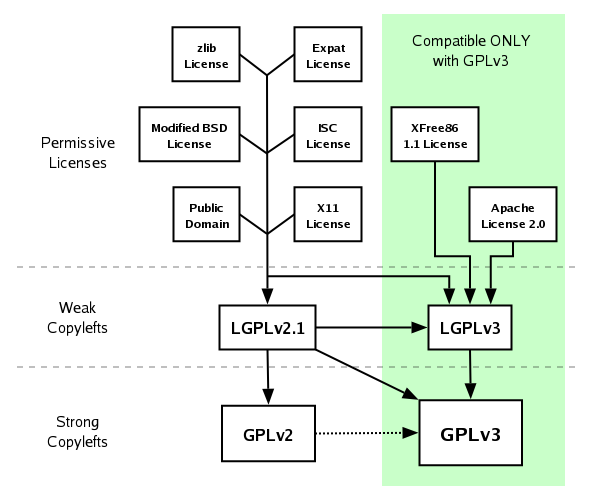
Arrows pointing from 1 license to another point that the first license is compatible with the second. This is true fifty-fifty if you follow multiple arrows to get from one license to the other; so, for example, the ISC license is compatible with GPLv3. GPLv2 is uniform with GPLv3 if the plan allows you to choose "any later version" of the GPL, which is the case for most software released under this license. This diagram is non comprehensive (see our licenses page for a more consummate listing of licenses compatible with GPLv2 and GPLv3), simply plainly illustrates that GPLv3 is compatible with just about everything GPLv2 is, and then some.
The GNU Affero GPL version three has besides been brought into the fold. The original Affero GPL was designed to ensure that all users of a web application would be able to receive its source. The GNU Affero GPL version 3 broadens this goal: it is applicable to all network-interactive software, then information technology will also work well for programs like game servers. The boosted provision is also more flexible, so that if someone uses AGPLed source in an awarding without a network interface, they'll only have to provide source in the same sort of way the GPL has always required. Past making these ii licenses compatible, developers of network-interactive software volition be able to strengthen their copyleft while notwithstanding building on acme of the mature body of GPLed code available to them.
More Means for Developers to Provide Source
I of the cardinal requirements of the GPL is that when you lot distribute object lawmaking to users, yous must too provide them with a way to get the source. GPLv2 gave you a few ways to do this, and GPLv3 keeps those intact with some clarification. It besides offers you new ways to provide source when you convey object code over a network. For instance, when yous host object code on a web or FTP server, you can simply provide instructions that tell visitors how to get the source from a third-party server. Thanks to this new choice, fulfilling this requirement should exist easier for many small distributors who only brand a few changes to large bodies of source.
The new license as well makes it much easier to convey object code via BitTorrent. Starting time, people who are merely downloading or seeding the torrent are exempt from the license'due south requirements for conveying the software. Then, whoever starts the torrent can provide source by simply telling other torrent users where it is available on a public network server.
These new options help continue the GPL in line with community standards for offering source, without making information technology harder for users to get.
Less Source to Distribute: New Organization Libraries Exception
Both versions of the GPL require you to provide all the source necessary to build the software, including supporting libraries, compilation scripts, and so on. They likewise describe the line at Organisation Libraries: you're not required to provide the source for certain core components of the operating system, such as the C library.
GPLv3 has adjusted the definition of System Library to include software that may non come up directly with the operating system, but that all users of the software can reasonably be expected to have. For instance, it now also includes the standard libraries of common programming languages such every bit Python and Blood-red.
The new definition likewise makes information technology articulate that yous tin can combine GPLed software with GPL-incompatible System Libraries, such as OpenSolaris' C library, and distribute them both together. These changes will make life easier for gratuitous software distributors who want to provide these combinations to their users.
A Global License
GPLv2 talks about "distribution" a lot—when you share the program with someone else, you're distributing it. The license never says what distribution is, because the term was borrowed from U.s.a. copyright constabulary. We expected that judges would look at that place for the definition. However, we later found out that copyright laws in other countries utilize the aforementioned discussion, but requite information technology unlike meanings. Because of this, a approximate in such a state might analyze GPLv2 differently than a gauge in the United States.
GPLv3 uses a new term, "convey," and provides a definition for that term. "Convey" has the aforementioned pregnant we intended for "distribute," merely now that this is explained directly in the license, it should be like shooting fish in a barrel for people everywhere to understand what nosotros meant. There are other minor changes throughout the license that volition also help ensure information technology is applied consistently worldwide.
When the Rules Are Broken: A Smooth Path to Compliance
Under GPLv2, if yous violated the license in any way, your rights were automatically and permanently lost. The only way to get them back was to petition the copyright holder. While a potent defence force against violations is valuable, this policy could cause a lot of headache when someone accidentally ran afoul of the rules. Asking all the copyright holders for a formal restoration of the license could be burdensome and costly: a typical GNU/Linux distribution draws upon the work of thousands.
GPLv3 offers a reprieve for good beliefs: if you violate the license, y'all'll go your rights back once you stop the violation, unless a copyright holder contacts you within lx days. After you receive such a observe, you can have your rights fully restored if you're a commencement-fourth dimension violator and right the violation inside 30 days. Otherwise, you can piece of work out the effect on a case-by-case basis with the copyright holders who contacted you, and your rights volition be restored afterward.
Compliance with the GPL has always been the summit priority of the FSF Compliance Lab and other groups enforcing the license worldwide. These changes ensure that compliance remains the top priority for enforcers, and gives violators incentive to comply.
The Latest and Greatest
Some of these changes probably seem less important to you than others. That'south okay. Every project is different, and needs different things from its license. Simply odds are that a number of these improvements will assist y'all and your piece of work.
And taken as a whole, all these upgrades stand for something more: we made a better copyleft. It does more to protect users' freedom, but information technology also enables more than cooperation in the gratis software community. But updating the license is only part of the job: in lodge for people to get the benefits it offers, developers need to apply GPLv3 for their projects, also. By releasing your own software under the new license, everyone who deals with information technology—users, other developers, distributors, even lawyers—will benefit. Nosotros promise you'll utilise GPLv3 for your adjacent release.
If you'd like to learn more nigh upgrading your projection to GPLv3, the FSF Compliance Lab would exist happy to assist you. Both on gnu.org and fsf.org, you can find basic instructions for using the license, and a FAQ addressing mutual concerns that people have about it. If your situation is more complicated than that, delight contact us and we'll do what we can to help yous with your transition. Together, we can help protect freedom for all users.
Source: https://www.gnu.org/licenses/quick-guide-gplv3.html
0 Response to "Does Eztag Read Liscense Plate or Sticker"
Post a Comment